
PLANNING | HC Guidance for CCs, LPPs & Community Development
HC’s Updated ‘Guide to the Planning System for Community Councils’ (and Communities)
“The purpose of planning is to manage the development and use of land in the long-term public interest.” Guide to the Planning System for Community Councils
The Highland Council’s updated ‘Guide to the Planning System for Community Councils’. Circulated by Highland Council March 2026; Document dated March 2023.
The document defines the core stages of planning and development, from small scale projects to major incoming developments, covering:
- Development Plan
- Development Management
- Development Enforcement
Topics covered include sections on:
Development Plans | National Planning Framework | Highland Wide Local Development Plan | Area Local Development Plans (Highland) | Engaging in the development process | Place Based Approach | LPP | Development Management | When permission is required | Permitted development | Development hierarchy | PANs | Application process | Consultees | CCs as Consultee | Material considerations | Committee or delegated decision | Listed buildings | Conservation areas | EIAs | Protection of trees | Planning Enforcement | Reviews and appeals etc
Local Place Plan (LPP) & Updates 12.05.26
- Enhance Local Livability: Improve public spaces, green infrastructure, local services and community facilities
- Support Sustainable Development: Identify sites for housing, business and industry, tourism infrastructure; enhance local economy and self-sufficiency
- Promote Sustainable Transport Solutions: Expand walking, cycling, and wheeling routes to reduce individual car dependency, increase health and promote low-carbon and shared solutions. Allocate sites and spaces for infrastructure related to sustainable transport solutions throughout the community.
- Build Climate Resilience: Propose flood mitigation, tree planting, low-carbon initiatives, enhance biodiversity and nature restoration.
- Preserve Heritage and Environment: Protect local wildlife, natural landscapes and wildland spaces, dark skies, historic buildings and structures; , plus enhance biodiversity, nature restoration, and dark sky protection.
- Establish appropriate homes for future generations:: Affordable, appropriate, and well placed homes for the needs of the community.
First Draft / Version 04.10.2025 | Out for Consultation (Now concluded in full)
Consultation of Local Place Plan_Draft_Version 04.10.2025
Strathnairn Community Council have set up a steering group to create a ‘Local Place Plan‘. We are now officially underway.
Local Place Plans can play a part in shaping regional development plans. For Strathnairn these wider plans are the Inner Moray Firth Local Development Plan 2 (IMFLDP2) or the (new) Highland Wide Local Development Plan (currently out for live consultation in 2025).

What is the National Planning System, why does it exist and how does it work?
- The UK Planning Process acknowledges that use or demand on land / sites / buildings is not static; with time however big or small – and driven by many and often conflicting pressures or opportunities – there is change or evolution.
- This process need to be transparent, considered and managed.
- Under the Scottish/UK Planning Process, this is known as ‘Development Planning’ and produces an overall ‘Development Plan’.
What is the ‘Development Plan’?
- At a national level there are 4 key parts to the Development Plan:
- (Nationally) Part 1. National Planning Framework (now NPF4). This is the overarching national planning document, informed by the development drivers in each of Scotland’s regions, but with a strategic and national overview.
- Whilst recognising the regional distinctions, this framework pulls all the regions together under a single a cohesive plan or structure.
- As such it is informed by Local Development Plans and a Regional Spatial Strategy.
- National Planning Framework 4_NPF4
- (Regionally or area based) Part 2. Local Development Plan.
- For Strathnairn there are two Local Development Plans which set the framework for development; the Highland-Wide Local Development Plan (currently being revised and due for release in Spring 2026); and the Inner Moray Firth Local Development Plan (adopted; with a focus on the Green Freeport and surrounds). Whilst specific to an area, the latter is still a Local Development Plan.
- Locally the IMFDP exists, as in the Highlands – given the geographical spread – there are big differences across the region, which can’t be fully captured in a single Highland-wide plan, so both sit side by side, talking to each other, with overlap.
- Local development plans therefore have a synergy – are both informed by and inform – the National Planning Framework and the Regional Spatial Strategy.
- Highland-Wide Local Development Plan_HWLDP
- (Regionally) Part 3. Regional Spatial Strategy. This is a map based diagram informed by the drivers, constraints and vision for development in the area, as a graphic.
- It connects directly to the NPF and LDP.
- Regional Spatial Strategy
- (Locally) Part 4. Local Place Plan(s).
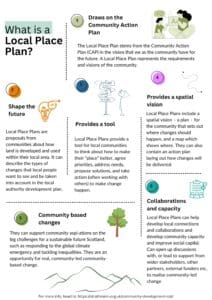
What is a Local Place Plan, why have one, and what is its purpose ?
- A Local Place Plan captures strategic community-led planning for the development (or preservation) of the community’s land, sites and buildings.
- It is informed by the community – collectively – through lived experience, local knowledge, and in considering or planning for the community’s future; both in addressing problems, but equally in recognising opportunities.
- Although Local and particular to a Place – and therefore at a Community level – it must have a natural synergy with the NPF and LDP; it can’t be in conflict with or disregard these plans, as they have greater weight.
- It can be focused on a single area within the community, but for Strathnairn Community Council, we are opting to pull the whole community together in a single plan that reflects the entire geographical area & Community Council boundary, with ‘soft boundaries’ into the neighbouring Straths.
- Given the diversity across the community, with settlements at the edge of Inverness (at Clava and Nairnside etc), through to the rural and remoter edges (at Croachy and Brin etc) along with the bearing on the community with the A9, it is expected that there will be distinctions across the area.
- Mapping and emerging information will reflect this.
- What will emerge is a strategy, or set of proposals for how – collectively – we (and all together as a singular community or series of settlements) would want to see our community’s land, sites and or buildings used going forward.
- It doesn’t have to account for each and every scrap of land; it is, as expressed a strategic overview, captured in words, maps and diagrams.
- This is then checked and validated by Highland Council, as the local and governing body.
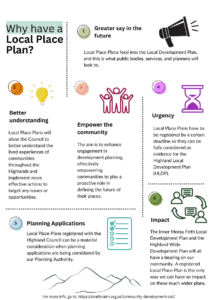
- The value of the Local Place Plan, is that it represents – as a spatial strategy and local framework in the broadest sense – the Community’s vision for its own area, at a local level; now and into the future.
- With this in place, it can inform, support or challenge proposed development, as one of the many ‘tools’ within the planning process.
- Critically it integrates communities directly with the planning process; which the CAP can’t do.
- As a standalone the LPP – or working along with the CAP – can also support community action, local development works, bids for funding across various stakeholders etc going forward.
What’s next?
- A fast paced, rough-around-the-edges, community exercise to produce a Local Place Place (which can be refined or finessed as we go) for which we need your (the community’s) engagement, input and help to get us there by the end of the year.
- Updates will be frequent, so please continue to check in.
- To date our neighouring communities of Strathdearn and Stratherrick and Foyers both have adopted LPPs.
- We understand the value of this exercise and look to strengthen Strathnairn’s place and voice – in particular in the regional planning system – and therefore are looking to move this forward.
- Consultation and engagement is being undertaken at a community-wide level, by SCC with the local community.
- Let’s do it together, as a community!
Let’s talk about Planning | Local Engagement / Awareness Raising / Knowledge building
For guidance on the relevance of Local Place Plans see
Highland Council guidance on LPPs
For information on Place Planning references and tools see:
An introduction to the Place Principle | Introduction to Place Principle
‘How good is our place’ Place Standard Toolkit | Place Standard Tool (How Good is Our Place)
Place Standard Toolkit & Inclusive Communication | Place Standard Toolkit
For more information about the related documents and their relevance to national, regional or local planning and development see:
National Planning Framework 4 to 2045 (NPF4) | National Planning Framework 4_NPF4
(New, single) Highland Wide Development Plan | Highland-Wide Local Development Plan (HWLDP)_The Highland Council
Inner Moray Firth Local Development Plan 2 (Adopted 2024) | Inner Moray Firth Local Development Plan 2 (IMFLDP2) | Inner Moray Firth Local Development Plan | The Highland Council
Highland Indicative Regional Spatial Strategy to 2050 | Regional Spatial Strategy
Community Development, Community Ownership & Other Local Opportunities
DAVIOT PRIMARY SCHOOL
What future would you like to see for our currently vacant Daviot Primary School?

Daviot Primary School has now been mothballed for the past nine months. A decision is due shortly on whether this will continue for another year or if the school will be permanently closed.
If permanent closure is agreed, the community will have the opportunity to consider a Community Asset Transfer—a process that allows local communities to take ownership or management of public buildings or land, often at reduced cost. This can enable us to repurpose the site in ways that benefit our area socially, economically, and environmentally.
There is real potential here to create something valuable for our community. For example:
- The two adjoining modular classrooms could be adapted into a community gym or fitness space
- The schoolhouse could be converted into affordable flats or family housing
- The surrounding land could, in time, support the development of additional affordable homes for local residents
Before any decisions are made, we want to hear from you—the people who live here, who understand what our community needs, and who will shape its future.
Please share your thoughts, ideas, or concerns with the Community Council or Strathnairn Development Company. Your input will help guide whether we pursue a Community Asset Transfer and what kind of use would best serve Daviot and the wider area.
This is a real chance to turn a closure into a new opportunity for local benefit.
Let’s make it count—together.
Have your say by emailing your comments to secretary@strathnairncc.com or cosec@strathnairncbf.com with title ‘Daviot Primary School‘.
DUNLICHTY CHURCH

A historic church, which has links to the Battle of Culloden, could become a heritage centre under new plans.
Strathnairn Heritage Association took over the former Dunlichity Church last year and has secured a £40,000 grant from the Scottish government. The group plans to further develop an archive about history of the area to the south of Inverness. Marks can be seen in walls in the church yard that are said to have been made by Jacobite soldiers sharpening their swords before Culloden in 1746.
Strathnairn Heritage Association chairman, Alasdair Forbes, said it was keen to help people who wanted to trace family links to the area. He said: “We get a lot of people coming from abroad every summer. If we can bring them here we can show them the history behind where they came from. We have a lot of information about the churches, the schools, Culloden all these sort of things. We’ll archive this and make it available for people to see.”
For full article as published see Church with Jacobite links to become heritage centre – BBC News
For more information on Strathnairn Heritage Association see Strathnairn Heritage Association | Home Page
Well done to Strathnairn Heritage Association for recognising the value of, and working to safeguard, the Community’s Asset.
More information relating to Community Ownership
ON COMMUNITY OWNERSHIP & COMMUNITY ASSET TRANSFERS
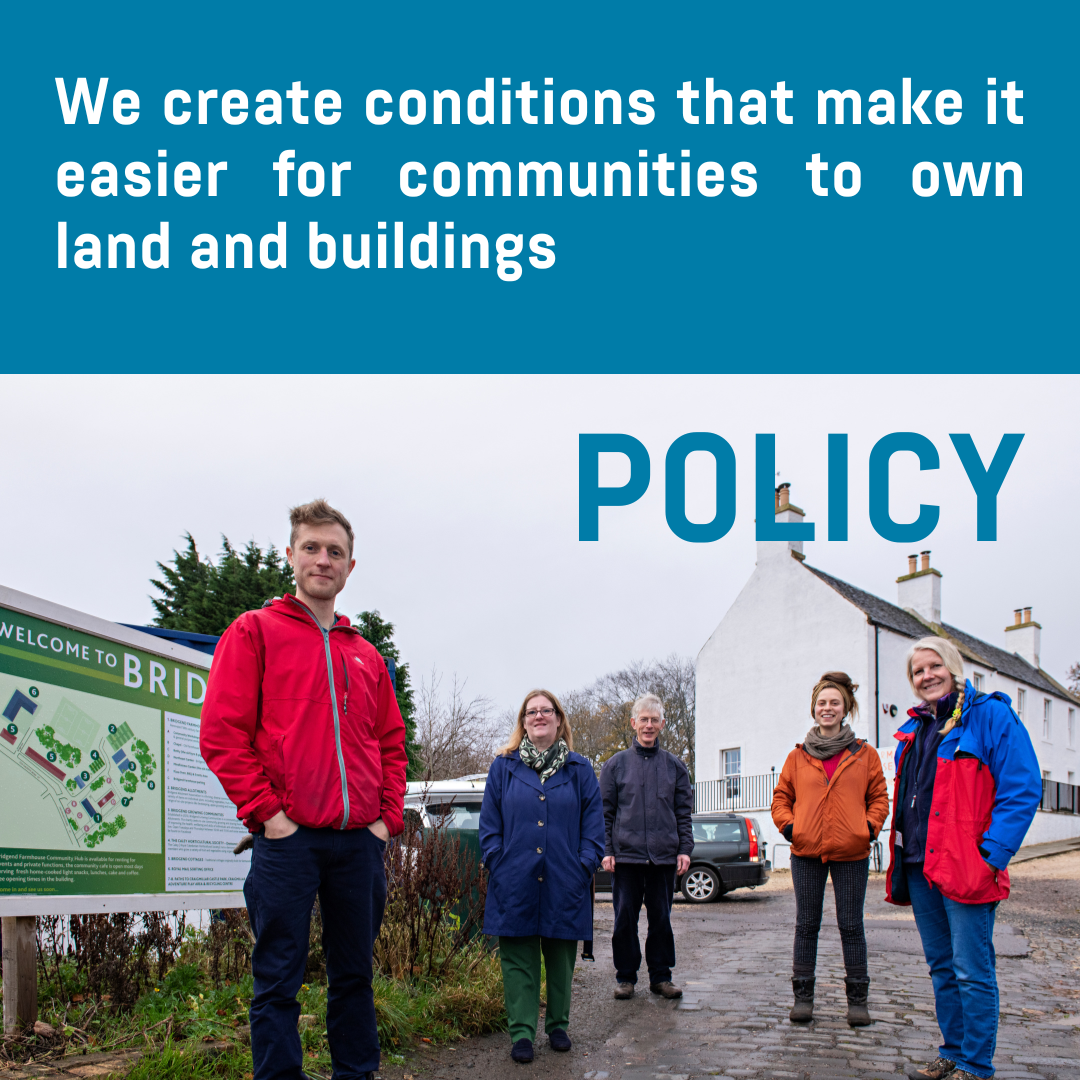
To better understand supporting policy & conditions see Community Land Scotland
To better understand Community Asset Transfers & gain Community Ownership Support
Community Asset Transfer | DTAS Community Ownership Support Service
To understand how the Community Empowerment Act 2015 relates to CATs
Asset transfer: Summary /guide
For Strathnairn’s local Development Trust
Strathnairn Development Company
ON FUNDING

For help to acquire land and other assets to take into Community Ownership see Community Land Scotland
For Highlands & Islands Enterprise (HIE) Advice & Guidance on Scottish Land Fund
For National Lottery Community Funding & Scottish Land Fund Applications
Scottish Land Fund | The National Lottery Community Fund
For Strathnairn Community Benefit Fund