
ENERGY GENERATION | Wind Farms, Solar, Hydroelectric etc
Wind Farms Information
ON EXISTING OR CONSENTED WIND FARMS WITH TURBINES <149.9m
Strathnairn saw its first operational wind farm in 2005 at Farr. More wind farms – as Dunmaglass (operational) & Aberarder (under construction) – have followed plus access tracks, power lines and a large substation at Garbole. ‘Clean’ wind across the high rolling hills of the Monadhliath and willing landowners makes our community an attractive prospect for wind farm developers. Access to Inverness harbour and the A9 makes construction easier and electrical grid connections are already in place (or with future infrastructure upgrades planned).
The benefits of green energy are well documented and supported by the Scottish and UK governments through their Net Zero target(s). Critics point to weaknesses – times when there is insufficient energy because the wind does not blow or too much for the grid to handle when it is very windy and under-investment in wave, tidal and nuclear power.
Although offshore windfarms are growing fast, onshore windfarms are considered to be the cheapest and easiest to build. In Strathnairn existing or approved windfarms – all of which currently include turbines sub 149.9m / at a height 110m – are ‘relatively’ carefully sited on high plateaus and basins out of sight of our homes.
HOW HAS THE COMMUNITY ‘BENEFITTED’ FROM WINDFARMS OPERATING OR CONSENTED HERE?
As part of the local engagement process – between the developer and the ‘host’ (or affected) community/communities – operators will typically make provision for an ‘agreed’ benefit to be made to ‘host’ communities when windfarms are operational. Community Benefit is intended to make a difference locally.
In Strathnairn, the ‘Strathnairn Community Benefit Fund’ has been established to manage community benefits from these operational large scale windfarms, within or affecting Strathnairn, on behalf of the whole community. Funding channeled to the community, in turn is being used to directly support or seed fund community need and / or improve lives. This is at an individual, household or community wide level. Decisions on how the funds are allocated or reinvested are made at a local level, by the community (through the SCBF); and are subject to strict governance, and an auditable trail.
Typically awards have been made or are considered for:
- Community based organisations such as Care in Strathnairn, the SCATA bus, the community halls and schools, together with other groups or projects aimed at providing direct community benefit for Strathnairn.
- Energy and energy-efficiency grants for households (including relieving Fuel Poverty)
- Education Grants (to support access to education, where support may otherwise not exist and is needed; and to improve the life chances of our younger generation through to 21 years).
- Large scale legacy projects for the future benefit of the community
- For fuller details see https://strathnairncbf.com/
WHAT SHOULD WE EXPECT WITH THE ‘NEXT GENERATION’ OF ONSHORE WIND? ON SCOPING WINDFARMS WITH TURBINES 150m+
As a community, 3 further new windfarm developments have entered or will enter the national planning system for decision making. These new developments represent the ‘next generation of onshore wind’. Permission is now being sought for the installation of 200m+ turbines – reflecting technological advances to turbine blades and structures – which in turn can harness more power. These are seen to positively contribute to addressing Climate Change.
However if approved, they will break skylines and the Zone of Theoretical Visibility (ZTV) (visibility when viewed from near or far and taking account of surrounding landforms etc) will change significantly owing to height and siting. An increased height change requires all structures (in excess of 150m) to be mounted with aircraft compliant (industrial) lighting; operated for all hours of ‘darkness’ and at times of poor visibility / low cloud. Of the applications scoping or coming through, these new generation of windfarms typically include battery storage structures at their base, to add to grid stability. More access tracks and above ground wires will therefore be required.
Over the projected 40-year lifespans, their individual and cumulative impact would be much greater than what we currently see; and naturally this needs to be fully considered and assessed. This is part of the consenting process.
HOW MIGHT OUR COMMUNITY AND OTHER COMMUNITIES ‘BENEFIT’ FROM THE NEXT GENERATION OF WINDFARMS IF CONSENTED?
In 2024, the Scottish Community Coalition on Energy (SCCE) published a paper A Fair Energy Deal for Scottish Communities calling for changes to community benefit associated with the next generation of windfarms / turbines as follows:
Increased community ownership
- With the aim of achieving 1GW of 100% community-owned energy by 2030.
Improved standards for community benefit
- For onshore wind, 4% of gross revenue should go to local community benefit fund(s) with a guaranteed floor of £7.5k/MW/year.
- For offshore wind, 1% of gross revenue should go to local community benefit fund(s) with a guaranteed floor of £2.5k/MW/year.
Establishing a Scottish Community Wealth Fund
- It could be seeded with the £750 million raised from the ScotWind auction, ensuring this wealth stays in Scotland and contributes to community wealth building (including more community-owned renewables and more shared ownership).
- In addition to payments to local community benefit funds detailed above, 1% of gross revenue from onshore wind developments, and 4% of gross revenue from offshore wind developments should go to a nationally coordinated Scottish community wealth fund.
- Norway’s sovereign wealth fund, created with its oil revenue, funds thriving communities. While recognising that the economics of oil and renewables are not the same, this demonstrates how when revenue from natural resources is managed it can have a huge impact on who benefits.
See ‘The demand for energy is increasing – how does this impact Scotland’s rural communities?‘ Dr Becky Ford, Community Energy Scotland / Institute for Northern Studies.
ReSourcE Spring/Summer 2025 : Royal Society of Edinburgh
Equally a report by Equitable Energy | Research (published in May 2025) on ‘Social value from renewables in the Highlands and Islands; Who benefits from the resources of a place?‘ can be downloaded below:
Platform London’s report on Social Value from Renewables
FORMING A COMMUNITY VIEW & MAKING A COMMUNITY REPRESENTATION AS PART OF THE PLANNING PROCESS
Your Community Council is required to gather and represent the views of all community members on these new developments to Scottish Ministers. We will be developing a range of means to ensure this happens. In the interim please see information coming through Strathnairn Community Council’s Facebook page, news & local monthly meetings etc.
Equally if you look to drop Strathnairn Community Council an email – in the interim – we can start to collate your views now. Ideally your comments should focus on ‘Material Considerations’. These include design and appearance, wildlife, nature, noise, landscape, well-being etc and compliance with existing policies. Purely private views like scenery and business losses can’t be considered.
The following links and information aim to help you make an informed opinion on these and other neighbouring wind farm developments.
Developer Websites
FOR WIND FARMS IN THE STRATHERRICK, STRATHDEARN & STRATHNAIRN COMMUNITY COUNCIL AREAS
These are the home websites for each wind farm. They contain maps, visualisations and timelines, also technical data such as number and height of turbines, power output, etc.
ESTABLISHED / OPERATIONAL (across the 3 Straths):
Farr Wind Farm Farr Wind Farm
Tom nan Clach Wind Farm Tom nan Clach Wind Farm
Moy Wind Farm Moy Wind Farm
Dunmaglass Wind Farm Dunmaglass Wind Farm
Glen Kyllachy Glen Kyllachy
CONSENTED / UNDER CONSTRUCTION (across the 3 Straths):
Aberarder https://www.sserenewables.com/onshore-wind/in-development/aberarder/
Corriegarth 2 https://www.baywa-re.co.uk/en/wind/corriegarth-2-windfarm
Cloiche https://www.sserenewables.com/onshore-wind/in-development/cloiche/
Dell http://www.dellwindfarm.co.uk/dell-wind-farm.aspx
PROPOSED / SCOPING:
Clune Wind Farm Clune Windfarm
- ECU 00005038
- 26 turbines @ 200m to tip of blade
- Status: Planning Submitted / Under Consideration (03 Mar 2025)
- 31 Public or Community Representations made to date (as of end of July 2025)
- Strathdearn Community Council’s Representation Application – Strathdearn Community Council Consultation Response – 28 May 2025 – ECU00005038 Clune Wind Farm.pdf
- Strathnairn Community Council’s Representation Application – Strathnairn Community Council Consultstion Response – 15 April 2025 – Clune wind farm.pdf
Highland Wind Farm Highland Wind Farm
- ECU 00005082
- 19 turbines @ 230m to tip of blade
- Status: Planning Submitted / Under Consideration (31 Mar 2025)
- Strathdearn Community Council’s Representation Application – Strathdearn Community Council Consultation Response – 08 June 2025 – The Highland Wind Farm_Redacted.pdf
Balnespick Wind Farm Balnespick Wind Farm
- ECU 00004904
- 9 turbines @ 200m to tip of blade
- Status: Planning Submitted / Under Consideration (20 Feb 2025)
- 7 Public or Community Representations made to date (as of end of July 2025)
- Strathdearn Community Council’s Representation Application – Strathdearn Community Council Consultation Response – Redacted – 07 May 2025 – ECU00004904 Balnespick WindFarm.pdf
Lynemore Wind Farm Lynemore Wind Farm
- ECU 00005105
- 14 turbines @ 200m to tip of blade
- Status: Planning Submitted / Under Consideration (01 May 2025)
- 131 Public or Community Representations made to date (as of end of July 2025)
- Strathdearn Community Council’s Representation Application – Strathdearn Community Council Consultation Response – 11 June 2025 – Lynemore Wind Fram__Redacted (1)
- Strathnairn Community Council’s Representation Application – Strathnairn Comunity Council Consultation Response – 15 July 2025 – Lynemore Wind Farm.pdf
Kyllachy Wind Farm Kyllachy Wind Farm
- 14 turbines @ 200m to tip of blade
- Status: Unknown (as of end of July 2025)
Carn Na Saobhaidh Carn Na Saobhaidh (Glen Mazaran)
- ECU 00005191
- 29 turbines @ 200m to tip of blade
- Status: Pre-Application / Scoping (as of end of July 2025)
Government Websites
Scottish Government Energy Consents Unit
Government considerations when assessing applications for wind farms with capacity in excess of 50 megawatts, overhead lines, wayleaves, and compulsory purchase orders. Also includes contact info for members of the public to make representations.
Applications for variation of section 36 consents
Section 36 of the Electricity Act 1989 (“the 1989 Act”) applies to proposals for the construction, extension or operation of an onshore electricity generating station whose capacity exceeds (or, when extended, will exceed) 50 megawatts (MW). This document provides guidance on the process for varying the consents granted under this Act.
Wind farms & the environment
John Muir Trust John Muir Trust | Wind Farm FAQs
The John Muir Trust is a leading voice for the UK’s wild places. We are dedicated to the conservation, protection and restoration of the UK’s wild places, for the benefit of all. 13 FAQs exploring wind farm impact on wild life, peatlands, woodlands, biodiversity, etc
John Muir Trust has also published it’s position on renewable energy development in the UK with a focus on onshore wind (and the associated grid infrastructure) in Scotland as a main threat to the UK’s wild places. John Muir Trust’s Position On Renewables
NatureScot (previously Scottish Natural Heritage) NatureScot (Advice about environmental impact)
The website provides advice to wind farm developers. This page lists links to “all of our standing advice and guidance documents, as well as to some key guidance documents published by other organisations. These can help both developers and planners to deliver the right development in the right place, by minimising impacts on nature and securing the benefits that nature can provide.“ The information is similarly useful to people wishing to check that developers are respecting our environment! The documents include lists of protected species, bird and animal habitats, sections on peatland, forestry, landscape, air pollution, environmental impact assessment, and much more.
Greenpeace Minerals for Energy Transition: Greenpeace’s Guiding Principles – Greenpeace International (Advice on materials & specification)
Greenpeace have now produced a guide on the rare earth minerals or metals, which are currently extracted or mined for components, storage or transmission of renewable energy. This guide focusses on where the minerals are sourced and the impact on local communities at this point of extraction. The purpose of these principles is to set out a pathway for ensuring that the supply and use of transition minerals is both just and equitable, and they can be adapted into local contexts.
Greenpeace_Minerals-for-transition_Guiding-principles_2025
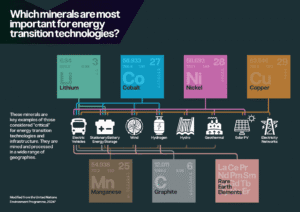
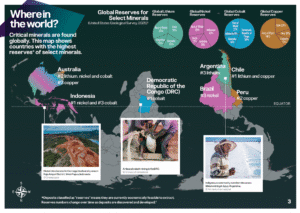
Materials or components specified in any proposed development should be fully traceable, transparent and accountable in terms of their extraction, manufacturing and transportation processes; and extracted or manufactured locally / nationally where possible at all times.
Miscellaneous
Download Map showing locations of proposed developments and cumulative impact – centred on Farr
Local Electricity Discount Schemes (LEDS)
“Local electricity discount schemes (LEDS) can be designed to provide an annual discount on the electricity bills of consumers living near participating wind farms. A scheme of this nature is one way of channeling funds received as part of the community benefit fund that wind farm operators share with communities living near wind farms.”
Local Energy Scotland
A consortium that administers and manage the Scottish Government’s Community and Renewable Energy Scheme (CARES). “Through CARES, we offer a range of financial support and advice to community groups to get local energy projects up and running. Our service is free and impartial, and we will support you at every stage – from initial planning, through development and funding applications, right up to and beyond the launch.”
Scotland Against Spin (Protection for the Scottish Landscape)
“We are the national voice for all those who seek real protection for the Scottish landscape as it is a key part of our national heritage, an important natural and economic asset and a valued amenity for residents and visitors alike. SAS is against the spin of the turbines, the spin of the developers and their lobbyists, and the spin of the Scottish Government.”
(Source: Strathdearn Community Council. Thanks for sharing this resource with Strathnairn Community Council)
ReSourcE Spring/Summer 2025 : Royal Society of Edinburgh
Royal Society of Edinburgh’s ReSource focuses on all the current and conflicting demands on Scotland’s Rural Environments & Communities. Heritage, energy, healthcare, ecology, the role of media in a rural context are all explored, as well as a pause to acknowledge the UHI’s Centre for Mountain Studies which celebrates its 25th year this year. Contributions from the RSE Fellowship, Young Academy of Scotland and a range of other experts all give insight into the various challenges and opportunities that rural Scotland has.
Community-held seminars
‘Be Informed | Stay Informed: On Wind Farms & Large Scale Infrastructure Projects plus Community Engagement & Community Response‘_28 Apr 25
Be Informed & Stay Informed_28 Apr 25
‘Making a representation to Energy Consents Unit‘_28 Apr 25
Making a representation to ECU_28 Apr 25
Highland Council Renewable Energy Projects Mapping_Live Mapping