
On Communities, Local Stakeholders & Major Energy Infrastructure | Holyrood Visit | 24 Feb 26
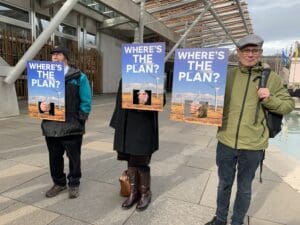
Where’s the Plan Scot Gov & ECU?
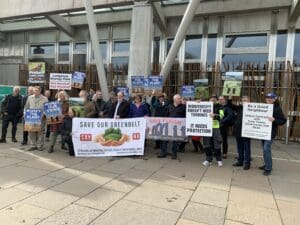
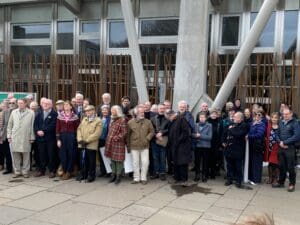
On Tuesday 24 Feb 2026, Community Councils across Rural Scotland came together and headed to Holyrood to give voice to their concerns and meet with SNPs Gillian Martin, Cabinet Secretary for Climate Action and Energy Gillian Martin | Scottish Parliament Website. This meeting – at the Scottish Parliament – follows on from first two Highland conventions, and later conventions representing the North-East of Scotland and Scottish Borders; with many rural communities in attendance in person or online.
On the day Chair & Councillor Helen Crawford stated that the ‘The Strategic Spatial Energy Plan (SSEP) is hurtling towards us in 2027’; and still projects continue to be consented – through ECU – without this in place. Facebook
Rural Scotland Convention on Major Energy Infrastructure Statements – 24 Feb 2026
National Energy Systems Operator (NESO) & Strategic Spatial Energy Plan (SSEP)
For full details on National Energy Systems Operator (NESO)’s Strategic Spatial Energy Planning (SSEP) due for release in early 2027 Strategic Spatial Energy Planning (SSEP) | National Energy System Operator
Rural Communities ARE seeking to engage; and are seeking more Local Control
It’s not about benefits, but it is about the ‘Cumulative Effect’ of what is landing on rural communities; without any local control, any overall construction phase management plan, any plan at all. Why are rural Scots blaming Holyrood for Westminster’s energy mess? | The National
It is also about balance and implementing a range of measures and solutions to reach Net Zero. https://www.telegraph.co.uk/business/2026/03/16/wind-industry-urges-miliband-restart-north-sea-drilling/
For starts ‘Community Engagement’ therefore needs to be recognised as a two-way process – with communities empowered to play their part – not simply used to inform communities of their fate. Planning Democracy – People’s voice in planning
For good practice on Community Engagement see Scottish Land Commission’s Protocol on community engagement
Summary of the day
Extracted from Councillor Helen Crawford’s FB – with thanks. Facebook
- A landmark day for community councils across Scotland.
- Yesterday, I chaired a roundtable at the Scottish Parliament with Cabinet Secretary for Climate Action and Energy, Gillian Martin MSP in attendance, representing community councils from the Highlands, South of Scotland, North East Scotland, Shetland, Ayrshire and Perthshire.
- This was the first time the Cabinet Secretary has listened directly to the Convention, made up of the very Community Councils that are expected to host major energy infrastructure, good people who represent the first tier of our Scottish democracy.
- At the roundtable, we urged the Scottish Government to introduce a time-limited pause on major energy infrastructure applications and a pan Scotland Planning Inquiry Commission. Solutions to avoid a chaotic energy roll out.
- Gillian Martin made a pledge that is vital to progressing the Convention’s concerns, to establish a forum to directly involve communities in discussions around the development of the Strategic Spatial Energy Plan. This is a result of the efforts of the Convention over the last two years.
- One vital next step is to give the Convention formal “Planning Stakeholder” status in that process – positioning impacted communities at the same table as the Scottish Government, GB Energy , NESO and developers. That would be true community engagement and I pressed the case for that specific ask as Chair.
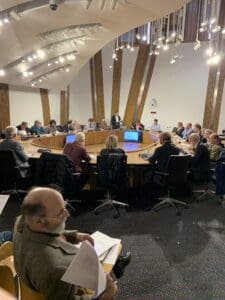
Capturing the mood | Rural Community Councils & Strathnairn CC’s Input
Locally, Strathnairn Community Council (SNCC) and Stratherrick & Foyers Community Council (SFCC) – plus many concerned communities across the Highlands and wider rural Scotland – were in attendance and represented. Several also attended by live link online.
Are there alternatives? Correspondence to Scot Gov
Short statement submitted to Ms Gillian Martin – by email – on 25 February 2025.
Dear Cabinet Secretary
I attended the convention at Holyrood on Tuesday 24 February and I noted you requested that various speakers made suggestions to address Net Zero. The suggestion that my Community Council feel is the answer you are looking for is to develop more offshore wind energy. This needs to be fast tracked. Please note the content of my speech – that I did not get the opportunity to present.
Offshore wind offers all the benefits that your Green Industrial Strategy sets out but you have failed to develop home grown solutions.
Yours
Rob Atkinson, For Strathnairn Community Council (SNCC)
Short statement from SNCC | Alternatives & Offshore Wind
A | The Problem >
- We have something like 193 turbines either built or in some stage of development and we understand more are coming;
- We are sandwiched between the Cairngorm National Park and a large “area of significant protection” to the north;
- This leaves our area zoned as an area “with potential for wind farm development”;
- The result is a feeding frenzy of land owners and developers applying to build and building large numbers of turbines;
- These turbines are of ever increasing height and visual impact and are now being proposed to have tip heights of 250m;
- This seeming unstopping industrial development is transforming our strath into an industrial landscape accompanied with the almost continuous roar from the turbines whenever a community is downwind;
- We are deluged with technical documentation and struggle to make representation to the planning authority due to the number of major energy related applications and the highly technical content of the documentation.
B | Why is This Happening? >
- As a community we believe in the need for human activity to be sustainable in order to protect the planet for our children and future generations;
- Net zero is a waypoint on that path and we support it as a target.
- However we don’t believe the proliferation of onshore turbines in the Highlands is a fair, sustainable or necessary strategy to achieve net zero;
- This is supported by the Analysis of Responses to Consultation July 2022 that notes that in response to question six the largest numbers of respondents saw a need for a more holistic approach to target setting and also to other renewable energy forms, in particular offshore wind;
- Currently there’s approximately 10 GW of installed onshore wind in Scotland.;
- The Onshore Wind Policy Statement 2022 is calling for a minimum of 20 GW of onshore wind to be installed by 2030 – approximately double the current installed capacity.
- This onshore target is driver for the proliferation of windfarms and leading to approving windfarms despite passionate and reasoned objections from local communities.
- It’s hard to imagine a Highlands with double the number of onshore windfarms but that seems to be the way we are heading.
C | There are Alternatives >
- As already said we are not climate deniers we support the target of net zero but to achieve it through continuing to develop our offshore wind sector;
- By continuing with the existing onshore strategy we are destroying one environment to save another – Offshore wind offers the opportunity to save both;
- We note and wholeheartedly welcome that at the Offshore Wind Conference the government announced an increase in the offshore wind target to 40GW but this needs to be more;
- We also note that The Green Industrial Strategy calls for Scotland to generate three times the domestic consumption by 2045 – this must only be achieved through offshore wind – there should be no requirement for another turbine to be installed in the
Highlands when considering the opportunity that exists in offshore wind; - In closing the Strathnairn Community Council welcomes and supports the Unified Statement of the Convention of Community councils.
For full proceedings of the day see Rural Scotland Convention on Major Energy Infrastructure Statements – 24 Feb 2026